Skip to content
Madison Foundation Repairs

Serving Madison and nearby areas

Bowing Basement Walls in Madison, WI

A bowing basement wall in Madison, WI means the soil outside is pushing harder than the wall can hold, and a free inspection tells you how far it has moved and what it takes to stop it.

Book a free foundation inspection

Tell us what you are seeing. A local specialist calls you back the same business day.

Why Madison basements leak and walls move

Much of Madison sits between two lakes on filled marsh, with a water table close to the surface. Wet, silty glacier soil freezes several feet deep each winter and pushes on basement walls, and many homes near the isthmus and campus have stone or block basements close to 100 years old.

What it costs

Typical published ranges for Madison. The contractor's written estimate is the price, and the inspection is free.

WorkTypical range
Inspection and written estimate Free
Wall anchor, installed $400 to $700per anchor
Carbon fiber straps, typical job $4,000 to $12,000
Bowing wall repair, typical range $4,000 to $15,000

See typical foundation repair prices in Madison

What a bowing wall looks like

A bowing wall is a basement wall that bends in toward the room. It does not happen overnight. In most Madison homes it creeps in a little more each winter until someone notices.

A bulge in the middle

Stand at one end and look down the wall. The center sits closer to you than the ends.

A top that leans in

The top of the wall has moved into the basement past the bottom.

A long sideways crack

It often runs along a mortar line a few rows of block below the top of the soil outside.

Blocks that stick out

One row of block sits out past the row below it.

Gaps at the top

A space opens between the top of the wall and the wood sill plate, or the floor joists above look pulled.

Corner cracks

Stair-step cracks zig-zag down from the top corners.

Check it yourself with a long level or a tight string from top to bottom. If the middle of the wall touches the string and the top and bottom do not, the wall is bowing.

Why Madison walls bow

The push comes from the soil outside. In Madison, three things add up to make that push strong.

Wet, heavy soil. The Dodge soil, first described in Dane County, has 2 to 3 feet of silt over glacial till, with a subsoil that is 25 to 32 percent clay, per the USDA. Soil like this holds water. Wet soil weighs more and presses harder on the wall.

A high water table. The City of Madison says many older neighborhoods sit on "made land," old wetlands and low spots that were filled to build homes. The city also says average yearly rain and snow have gone up about 3 inches over the last 20 years, and ground water has risen to meet basements in many of those areas. Water in the soil adds pressure right where the wall is weakest.

Deep frost. Wisconsin's home code asks for footings at least 48 inches below grade to get under the frost. In February 2014, Madison Water Utility reported frost 4 to 5 feet down. When wet soil freezes, it swells. Frozen soil near the top of the wall pushes sideways on the upper rows of block. That is why so many Madison walls crack and bow a few feet below the ground line, not at the bottom.

Block walls and stone walls bow differently

Concrete block walls are built in rows held by mortar. The mortar joints are the weak spots, so a block wall tends to crack along one long joint and fold in at that line.

Older stone walls, common in homes near the isthmus and campus, move another way. The Wisconsin Historical Society says water and tree roots can make sections of old stone foundation bow inward, and that crumbling mortar and stair-step cracks are common. Stone walls often bulge in one spot rather than along a straight line.

Cosmetic or urgent?

Watch it if the wall is straight, a crack is thin, and nothing has changed in a year. Mark the crack ends with a pencil and a date.

Have it checked soon if you can see or measure any bow, the sideways crack is wider than a coin edge, or blocks have shifted.

Call now if the wall moved since last season, if the bow is more than about an inch, or if water is coming in along the crack. Each freeze adds to the push, and fall is the time to act before the ground freezes again.

How bowing walls get fixed

The fix depends on how far the wall has moved and how much room there is outside.

Wall anchors

A steel plate goes on the inside of the wall, tied by a rod to an anchor buried in the yard. Some can be tightened over time.

Carbon fiber straps

Flat straps are glued up the wall. They work for walls that have moved only a little and leave a thin, clean finish.

Steel braces

Beams run from the basement floor to the floor framing above. They hold the wall and need no digging outside, which helps on tight city lots.

Dig out and rebuild

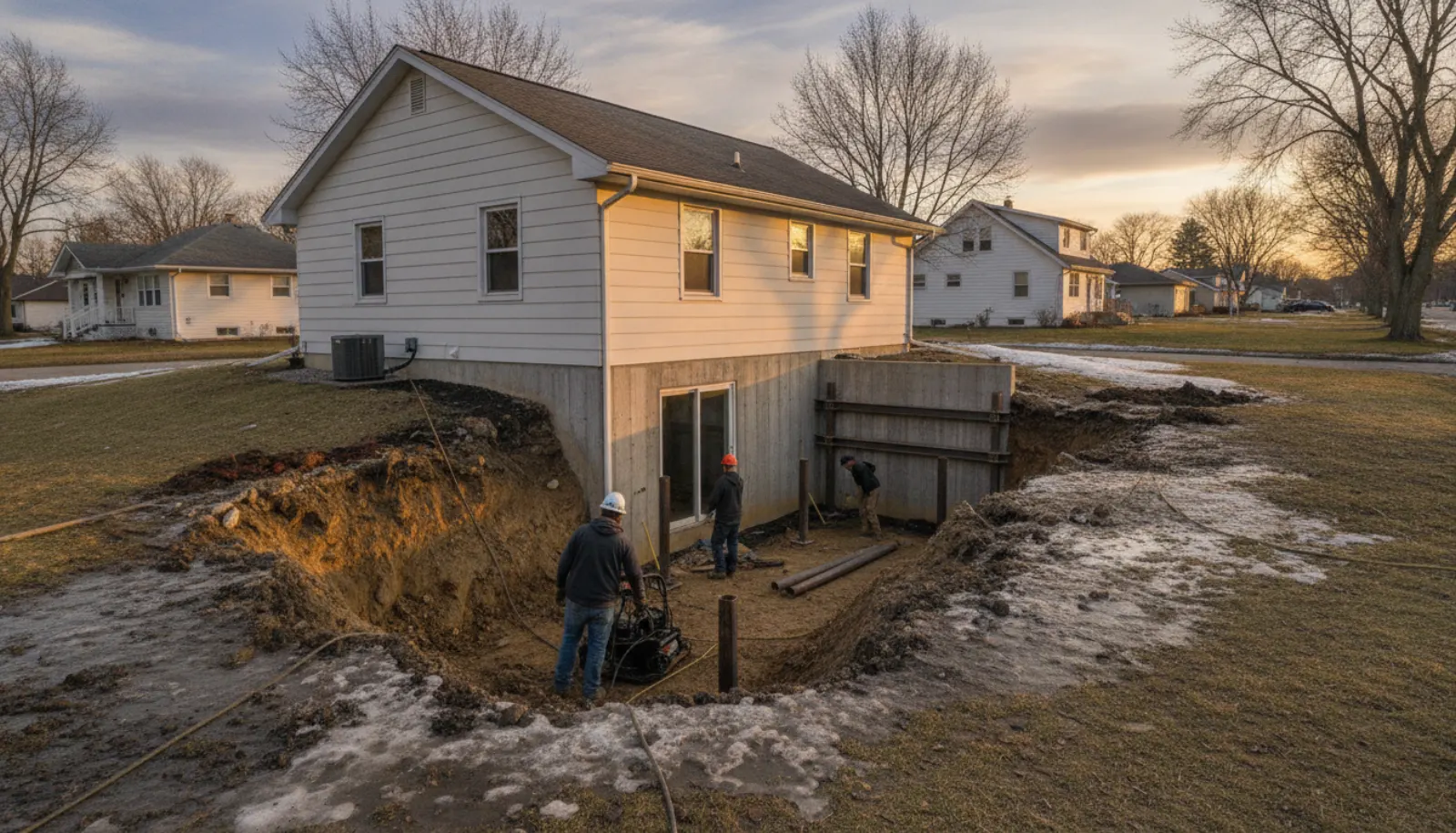
For a wall that has moved too far, the crew digs outside, straightens or rebuilds the wall, and adds drainage before backfill.

Bracing stops the movement, but water will keep pushing unless it has somewhere to go. Many Madison jobs pair the wall fix with downspout changes, regrading or an inside drain.

What it usually costs

Published cost guides put bowing wall repair at about $4,000 to $15,000 for a typical job. Wall anchors run about $400 to $700 each, often spaced about every 5 feet. Carbon fiber strap jobs are often $4,000 to $12,000. These are typical ranges, not quotes. Your price depends on wall length, how far it moved, and whether water work is needed too.

Before the inspection

  • Take a photo of the wall today, with a tape measure in the shot, so you can compare later.
  • Measure the bow with a level or string and write it down.
  • Move boxes and shelves at least 3 feet off the wall so the inspector can see it.
  • Make sure downspouts drain several feet away from that side of the house.
  • Note when you first saw the bow and whether water comes in.

Frequently asked questions

How much bowing is too much?

There is no single number that fits every wall. Many repair crews treat a wall that has moved in about an inch or more, or one that keeps moving season to season, as one that needs bracing soon. A wall that is still moving is the bigger worry than the exact number.

Can a bowing wall be pushed back straight?

Sometimes, a little. Wall anchors can be tightened slowly over months to pull some walls back. Walls that have moved far, or cracked through, are usually held where they are or rebuilt.

Will my basement wall collapse?

Sudden collapse is rare. Most walls move slowly over many winters. But a wall that leans more each year will keep going, and the fix gets bigger the longer it waits.

Is it safe to sell a house with a bowing wall in Madison?

You can sell it, but a buyer's inspector will find it. Many sellers fix it first and hand over the paperwork and warranty, since buyers often walk away from an open foundation problem.

Do I need an engineer or a contractor?

A foundation crew can tell you the options and give a price. If you want a second opinion with no repair to sell, a structural engineer can write a report. Some lenders and buyers ask for one.

Get the wall looked at

Call (608) 719-3321 or send the short form. A local crew will call you back, measure the wall, and give you a written price. The inspection is free.

(608) 719-3321 Free inspection