Skip to content
Madison Foundation Repairs

Serving Madison and nearby areas

Water in Basement in Madison, WI

Water in a basement in Madison, WI is usually ground water or roof water finding the easiest way in, and a free inspection finds where it enters and what will keep it out.

Book a free foundation inspection

Tell us what you are seeing. A local specialist calls you back the same business day.

Why Madison basements leak and walls move

Much of Madison sits between two lakes on filled marsh, with a water table close to the surface. Wet, silty glacier soil freezes several feet deep each winter and pushes on basement walls, and many homes near the isthmus and campus have stone or block basements close to 100 years old.

What it costs

Typical published ranges for Madison. The contractor's written estimate is the price, and the inspection is free.

WorkTypical range
Inspection and written estimate Free
Gutters and downspouts $3 to $30per linear foot
Regrading the yard $500 to $3,000
Crack injection $250 to $1,000per crack
Inside perimeter drain tile $40 to $120per linear foot
Basement waterproofing, most projects $3,000 to $10,000

See typical foundation repair prices in Madison

First, where is it coming in?

Water in a basement can come from three places. The fix for each is different, so the first job is finding which one you have.

Water at the floor joint

A wet line where the wall meets the floor, all the way around or along one side. This is usually ground water pushing up and in.

Water up through the floor

Damp spots or puddles in the middle of the floor, or water around the floor drain. Also ground water, rising from below.

Water through a crack

A wet streak down from one crack in the wall. Water in the soil is using the crack as a path.

Water near a window well

A well that fills and spills over. Usually roof or yard water, not ground water.

Water after one heavy storm only

Often a gutter, downspout or low spot sending roof water to the wall.

Dirty water from the floor drain

That is a sewer backup, which is a plumbing problem, not a foundation one.

A simple test helps. Tape a square of plastic wrap to a damp spot on the wall for two days. Water on the room side means humid air. Water on the wall side means it is coming through.

Why Madison basements take water

The ground is wet to begin with. Much of Dane County was once wetland, which means a shallow water table, county officials told reporters after the 2018 floods. The City of Madison says many older neighborhoods sit on "made land," old wetlands and low areas filled to build homes.

There is more water than there used to be. The city says average yearly rain and snow have gone up about 3 inches over the last 20 years, and that ground water in many filled areas has risen into conflict with basements. In August 2018, parts of Dane County got 11 to 15 inches of rain, and Madison had its second-wettest year in 149 years of records. Officials warned that many owners think the problem is the lakes, when it is really the water in the ground coming up.

The soil holds it. USDA describes the Dodge soil of Dane County as silt over glacial till with a clay-rich subsoil. Water sits in soil like that and presses on the wall instead of draining away.

Snowmelt. Each spring, a winter of snow melts into ground that is still frozen below. The water has nowhere to go but sideways, toward your foundation.

Older walls. Old stone and block walls have many joints. The Wisconsin Historical Society says constant wetness on an old stone foundation is a warning sign, and that sloping soil away and adding downspout extenders is the first fix.

When it is a nuisance and when it is urgent

A nuisance if you get a little dampness once or twice a year, with no crack or wall movement.

Fix it this year if water comes in every spring, if there is white powder or peeling paint, or if you smell must.

Act now if water comes in during most rains, if it comes through a crack that is growing, if a wall near the water is bowing, or if your sump pump cannot keep up.

How it usually gets fixed

Most fixes start cheap and outside, then move inside if the water is ground water.

Gutters and downspouts

Clean gutters and run downspouts several feet from the house. This alone fixes many one-side leaks.

Regrading

Build up soil so it slopes away from the wall. Patios and walks that tilt toward the house may need to be fixed too.

Crack injection

A single leaking crack in a poured wall can be sealed from inside.

Inside drain tile and a sump pump

A strip of floor is cut along the walls, a drain pipe is laid in gravel, and water flows to a pump that sends it out. This is the common fix for ground water because it works with the high water table instead of fighting it.

Outside waterproofing

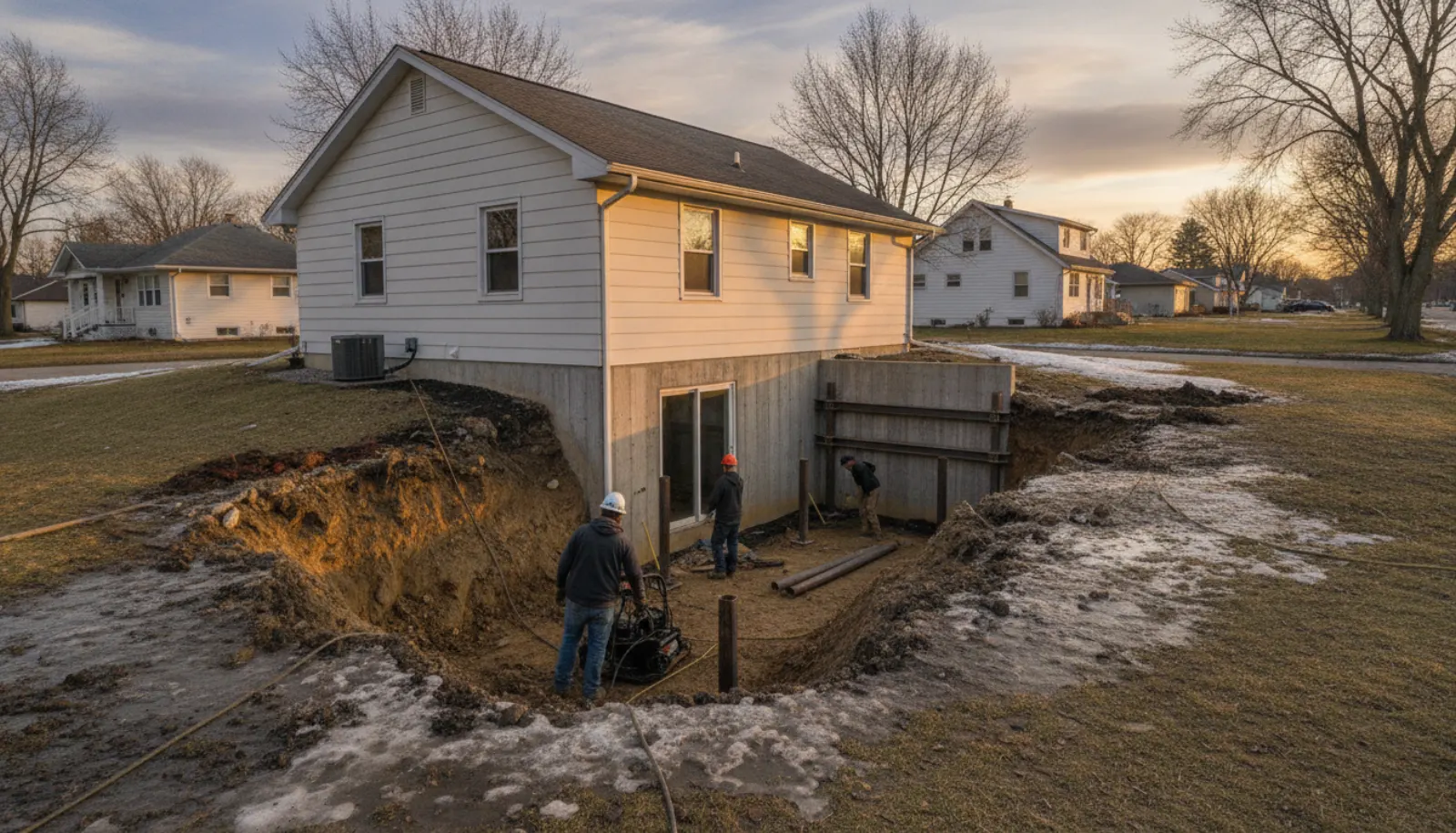
Digging down to coat the wall and add drain pipe. Effective but costly, and hard on tight lots.

Typical costs

From published cost guides: gutters and downspouts about $3 to $30 per linear foot, regrading about $500 to $3,000, crack injection about $250 to $1,000 per crack, and inside drain tile about $40 to $120 per linear foot. Most full waterproofing projects fall between $3,000 and $10,000. These are typical ranges, not quotes.

What to do before the inspection

  • Dry the floor with a wet vac and run a dehumidifier to stop mold.
  • Move boxes and anything made of paper or cloth up off the floor.
  • Take photos of where the water was, with the date.
  • Go outside in the rain if you can. Watch where the downspouts and gutters put the water.
  • Lift your sump pump float to make sure it runs.
  • Do not run sump or downspout water into a floor drain or sink.

Public Health Madison and Dane County reports that about half of homes tested in the county had high radon, and radon comes in through the same cracks as water. A radon test is cheap and worth doing while you are at it.

Frequently asked questions

Why is there water in my basement when it has not rained?

In Madison, it is often ground water. The city says rising rain and snow over the years have pushed ground water up into basements in many older areas built on filled wetlands. That water can come in for weeks after the last storm.

Is water at the bottom of the wall a foundation problem?

It is a water problem first. But water that soaks the soil also adds weight against the wall, and over many winters that can crack or bow it. Fixing the water often protects the wall too.

Will homeowners insurance cover water in my basement?

It depends on the cause and your policy. Many policies treat ground water seepage, sewer backup and flood differently, and some need an add-on. Call your agent and ask about each one before you need it.

Can I just seal the walls from the inside?

Paint and sealers can help a damp wall. They rarely stop water that is pushing in under pressure, which lifts the paint and comes in at the floor joint. Most lasting fixes give the water a path to a pump.

Should my sump pump drain into the floor drain?

No. The City of Madison says sump pumps tied to the sanitary sewer are not allowed and can lead to sewage backups into your basement. Sump water belongs outside or in the storm sewer.

How soon should I deal with a wet basement?

Dry it out within a day or two to stop mold, then find the source before the next wet season. Spring snowmelt is when most Madison basements take water, so fall is a good time to fix it.

Find where the water gets in

Call (608) 719-3321 or send the short form. A local crew will call you back, track down the source, and give you a written price. The inspection is free.

(608) 719-3321 Free inspection