Skip to content
Madison Foundation Repairs

Serving Madison and nearby areas

Horizontal Crack in Basement Wall in Madison, WI

A horizontal crack in a basement wall in Madison, WI usually means soil pressure is pushing the wall in, and a free inspection tells you whether it is moving and what it takes to hold it.

Book a free foundation inspection

Tell us what you are seeing. A local specialist calls you back the same business day.

Why Madison basements leak and walls move

Much of Madison sits between two lakes on filled marsh, with a water table close to the surface. Wet, silty glacier soil freezes several feet deep each winter and pushes on basement walls, and many homes near the isthmus and campus have stone or block basements close to 100 years old.

What it costs

Typical published ranges for Madison. The contractor's written estimate is the price, and the inspection is free.

WorkTypical range
Inspection and written estimate Free
Crack sealing or injectionOnly after the wall is stable $200 to $1,000
Wall anchor, installed $400 to $700per anchor
Bowing wall repair, typical range $4,000 to $15,000

See typical foundation repair prices in Madison

Why this crack is different

Most cracks in a basement are thin lines that run up and down. They come from concrete shrinking as it dries, and most are harmless. A horizontal crack runs the other way, side to side, and it has a different cause. Something outside is pushing on the wall.

In Madison, that push almost always comes from wet soil and frost. This page is about that one crack: how to read it, why it forms, and what it takes to stop it.

What you will notice

A long crack along one mortar line

On a block wall it follows a single row, often across most of the wall.

It sits a few rows below the ground line

Usually two to four rows of block down from the top, not near the floor.

One side sticks out

Run your hand across it. If the lower block sits out past the upper block, or the other way, the wall has shifted.

Damp or white powder along the line

Water uses the crack as a path in.

Stair-step cracks at the ends

The horizontal line often turns into zig-zag cracks near the corners.

A bow above or below it

The wall bends in at the crack line.

Why it forms in Madison

Frost. Wisconsin's home code asks for footings at least 48 inches below grade because frost goes deep here. In February 2014, Madison Water Utility reported frost 4 to 5 feet down. Wet soil swells as it freezes and pushes sideways. The upper rows of a block wall have the least weight on top to hold them, so they give first.

Water in the soil. The City of Madison says many older neighborhoods were built on filled wetlands, and that rising rain and snow have pushed ground water up into conflict with basements. Soil that cannot drain builds water pressure against the wall. Repair crews note that cracks from this kind of pressure often form part way up the wall, where the push is strongest.

Clay-rich soil. USDA describes the Dodge soil of Dane County as silt over glacial till, with a subsoil that is 25 to 32 percent clay. Soil like that holds water against the wall longer after rain and snowmelt.

Block construction. A block wall is many small units held by mortar joints. Each joint is a weak line, so pressure shows up as a long crack along one of them. About 1 in 3 Madison housing units was built between 1950 and 1979, per Census data, so a lot of Madison basements are now 45 to 75 years into this yearly cycle.
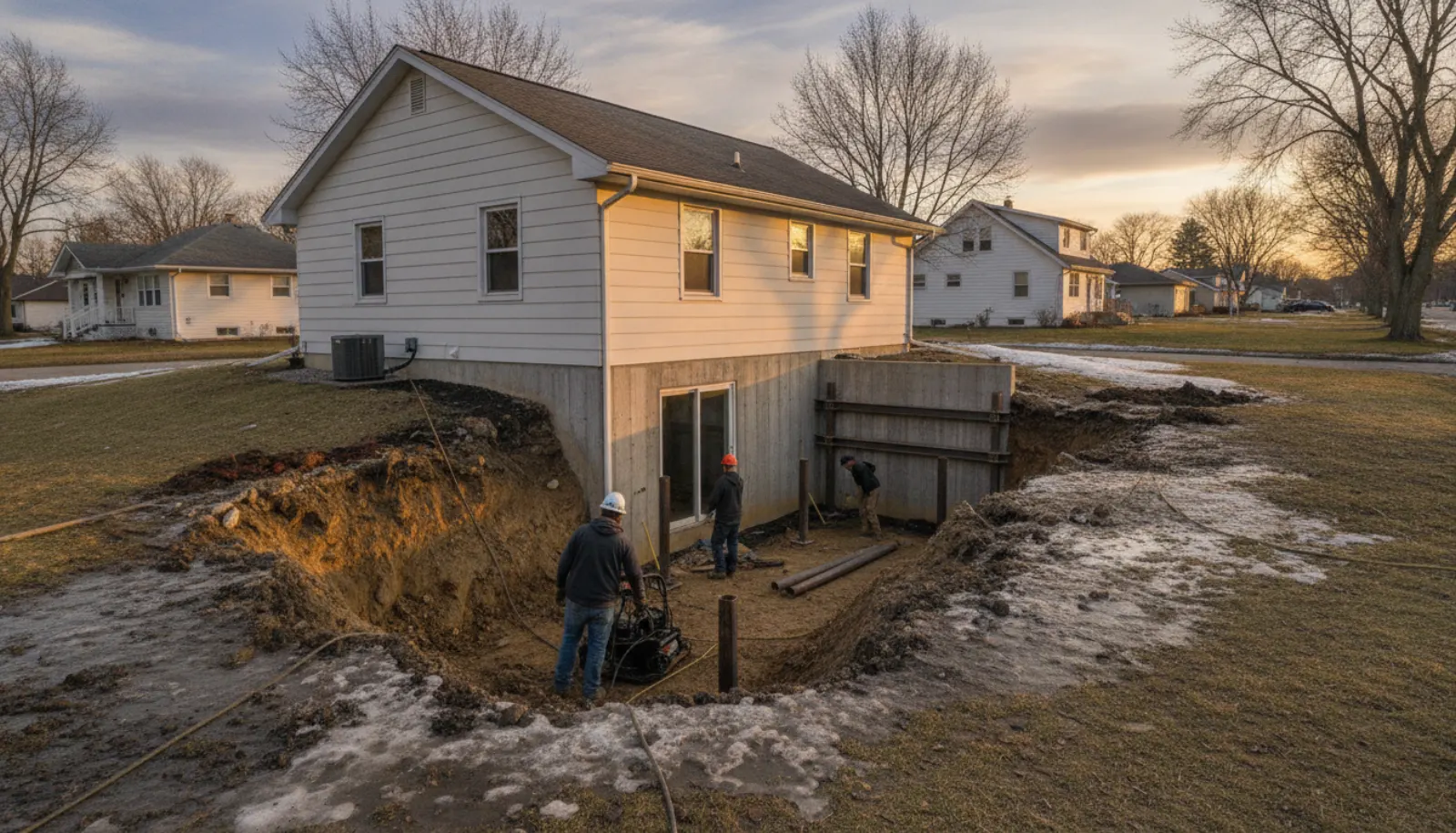
Cosmetic or urgent?

Probably stable if the crack is hairline, flat (both sides line up), dry, and has not changed in a year or more. Mark the ends and the widest point with a pencil and the date, and check after the next thaw.

Have it checked soon if the crack is wider than a coin edge, leaks, or has white powder along it.

Call now if one side sticks out past the other, if the wall bows at the crack, or if the crack grew since last season. A wall that is moving keeps moving each winter.

How it gets fixed

A horizontal crack is fixed in two steps. First the wall gets held so it stops moving. Then the crack and the water get dealt with.

Hold the wall

Wall anchors tied to the yard, carbon fiber straps glued to the wall, or steel braces from floor to framing. The choice depends on how far the wall moved and how much room there is outside.

Relieve the water

Downspouts carried well away, soil sloped away from the house, and on wet lots an inside drain to a sump pump.

Seal the crack

Once the wall is stable, the crack can be filled so it stops leaking.

Rebuild if needed

If blocks have slid far or broken through, that section may need to be dug out and rebuilt.

Sealing a moving crack without holding the wall is the most common wasted spend. The filler cracks again by next spring.

Typical costs

Crack sealing or injection runs about $200 to $1,000 per published cost guides. Wall anchors run about $400 to $700 each. A full bowing wall repair is often $4,000 to $15,000. These are typical ranges, not quotes. If the crack turns out to be stable, your price may be just the sealing.

Before the inspection

  • Photograph the full crack with a ruler or coin for scale.
  • Note the month you first saw it and whether it has grown.
  • Clear shelves and boxes off that wall.
  • Look outside on the same side. Note low spots, downspouts that dump next to the wall, or a patio that slopes toward the house.
  • Check whether water comes in along the crack after rain.

Frequently asked questions

Is a horizontal crack in a basement wall always serious?

It is the crack type to take most seriously, because it usually comes from soil pushing in, not from concrete drying. A thin one that has not changed in years may be stable. Have it checked once so you know which kind you have.

Can I just fill the crack with caulk or hydraulic cement?

Filling it can slow water, but it does not stop the wall from moving. If the wall is being pushed, the crack opens again and the filler pops out. Bracing comes first, sealing second.

Why is the crack only a few rows down from the top?

That is about where frozen soil and wet soil push hardest on a block wall. In Madison, frost can go 4 to 5 feet deep in a cold winter, so the upper rows of block take the sideways push.

Will the crack get worse in winter?

Often, yes. Wet soil swells as it freezes. Many owners first see the crack, or see it widen, in late winter or spring after the thaw.

Does a horizontal crack let in radon?

Any crack can let in radon. Public Health Madison and Dane County reports about half of homes tested in the county had high levels. A test kit is cheap and worth doing.

Find out if it is moving

Call (608) 719-3321 or send the short form. A local crew will call you back, check the wall, and give you a written price. The inspection is free.

(608) 719-3321 Free inspection