Skip to content
Madison Foundation Repairs

Serving Madison and nearby areas

Sinking Foundation in Madison, WI

A sinking foundation in Madison, WI means part of the house is settling into soft or wet ground, and a free inspection tells you whether it is still moving and what it takes to hold it.

Book a free foundation inspection

Tell us what you are seeing. A local specialist calls you back the same business day.

Why Madison basements leak and walls move

Much of Madison sits between two lakes on filled marsh, with a water table close to the surface. Wet, silty glacier soil freezes several feet deep each winter and pushes on basement walls, and many homes near the isthmus and campus have stone or block basements close to 100 years old.

What it costs

Typical published ranges for Madison. The contractor's written estimate is the price, and the inspection is free.

WorkTypical range
Inspection and written estimate Free
Steel or helical piers $1,000 to $3,000each
Slab or step lifting (mudjacking, foam) $500 to $1,900
Major foundation repairs in Madison $2,500 to $26,200

See typical foundation repair prices in Madison

What sinking looks like

A sinking foundation is not the same as a bowing wall. Bowing is a wall being pushed in from the side. Sinking is part of the house going down. In Madison, it often shows up at one corner, an addition, a porch, or a chimney.

A crack that is wider at the top than the bottom

Or the other way around. The wall is bending as one end drops.

Stair-step cracks near a corner

In block or brick, the crack zig-zags down toward the low spot.

An addition pulling away

A gap opens where the new part meets the old house.

A porch or stoop tilting

It drops away from the door or leans out.

A chimney leaning or separating

A gap grows between the chimney and the siding.

Floors sloping toward one side

A marble rolls one way, every time.

Doors and windows that stop closing

Gaps at the top on one side, all year long.

Drywall cracks that come back after patching

Especially from the corners of doors and windows.

Why parts of Madison sink

Soft ground near the lakes. Engineers who drill test holes in Madison describe the ground as a mix of glacier and old lake bed deposits, with soft organic silt in the upper soils near the Yahara River and the two lakes. They also note that two borings 50 feet apart can hit different soil. That means one corner of a house can sit on firmer ground than another, and the soft side settles more.

Filled land. The City of Madison says many older neighborhoods sit on "made land," old wetlands and low areas filled, to differing depths, to build homes. Much of the isthmus was once marsh. Fill that was not packed well, or that sits on soft soil below, keeps settling for years under the weight of a house.

Water. The city says rising rain and snow have pushed ground water up in many of these areas. Soil that goes from soaked to drier and back again shifts under footings. Downspouts dumping at one corner can soften the soil right there.

Frost and shallow footings. Wisconsin's home code asks for footings at least 48 inches below grade to get under the frost, and Madison Water Utility reported frost 4 to 5 feet down in February 2014. Porches, stoops and some older additions were not always built that deep. Frost lifts them in winter and lets them drop in spring, and they slowly work out of line.

Cosmetic or urgent?

Probably old, stable settling if the cracks are thin, have not changed in a year, and doors work fine. Many older Madison homes settled long ago and stopped.

Have it checked soon if a crack is wider at one end, an addition gap is growing, or one floor slopes noticeably.

Call now if cracks are getting wider month to month, doors that worked last season no longer close, or a chimney or porch is visibly leaning. Settling that is still active usually does not stop on its own.

How sinking foundations get fixed

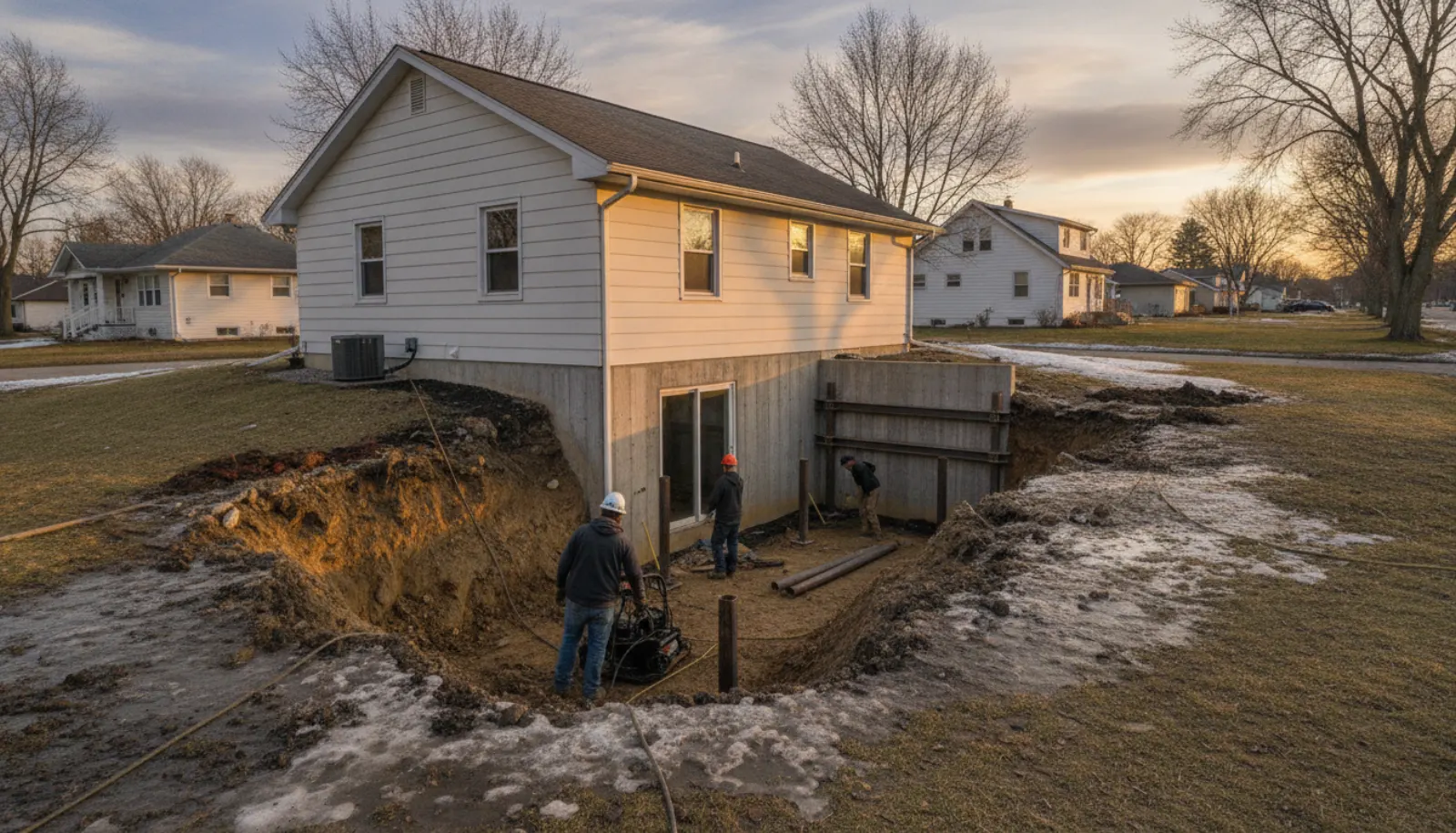
The fix carries the weight of the house down past the soft soil to firmer ground.

Steel push piers

Steel pipes are driven down beside the footing until they hit firm soil, then a bracket ties them to the footing. The house can sometimes be lifted part of the way back.

Helical piers

Steel shafts with screw plates are turned into the ground. Good for lighter loads like porches and additions.

Slab and step lifting

For a sunken stoop, walk or slab, grout or foam is pumped under to raise it. Cost guides note this is cheaper but does not fix the soil underneath.

Drainage

Downspouts carried away and soil sloped away, so the soil under the footing stops changing.

Crack repair after

Once the house is held, cracks inside and out can be sealed.

Typical costs

From published cost guides: steel or helical piers run about $1,000 to $3,000 each. Lifting a sunken slab or step runs about $500 to $1,900. Major foundation repairs in Madison, including piers, run about $2,500 to $26,200. A sinking corner might need a few piers. A whole side might need many. These are typical ranges, not quotes.

Before the inspection

  • Mark the ends and width of key cracks with a pencil and the date.
  • Roll a marble or use a level on floors that feel off. Note the direction.
  • Measure any gap at an addition or chimney and photograph it with a ruler.
  • Check that downspouts on the low side drain several feet away.
  • Write down any door or window that changed and when.

Frequently asked questions

Is it normal for a house to settle?

A little settling in the first years is normal and even. Settling that keeps going, or one part of the house dropping more than the rest, is not. Cracks that come back and doors that stop closing are the clues.

Can a sinking foundation be lifted back up?

Often, partly. Steel piers driven to firm soil can be used to raise a settled corner some of the way back. How much depends on the house and how long it has been down. The crew should tell you what lift to expect before the work starts.

Why is only my addition or porch sinking?

Additions and porches often sit on smaller or shallower footings than the main house, sometimes on soil that was never packed down well. They settle on their own and pull away at the joint.

How long does pier work take?

Many pier jobs take one to three days. The crew digs small holes at the footing, drives the piers and sets brackets. Your written estimate should list the schedule.

Do I need a permit for foundation piers in Madison?

The City of Madison says alterations to one and two family homes need a permit, depending on the job. A Wisconsin contractor needs a state dwelling contractor credential to pull one. Ask the crew to confirm and pull any permit needed.

Find out if it is still moving

Call (608) 719-3321 or send the short form. A local crew will call you back, check the house, and give you a written price. The inspection is free.

(608) 719-3321 Free inspection